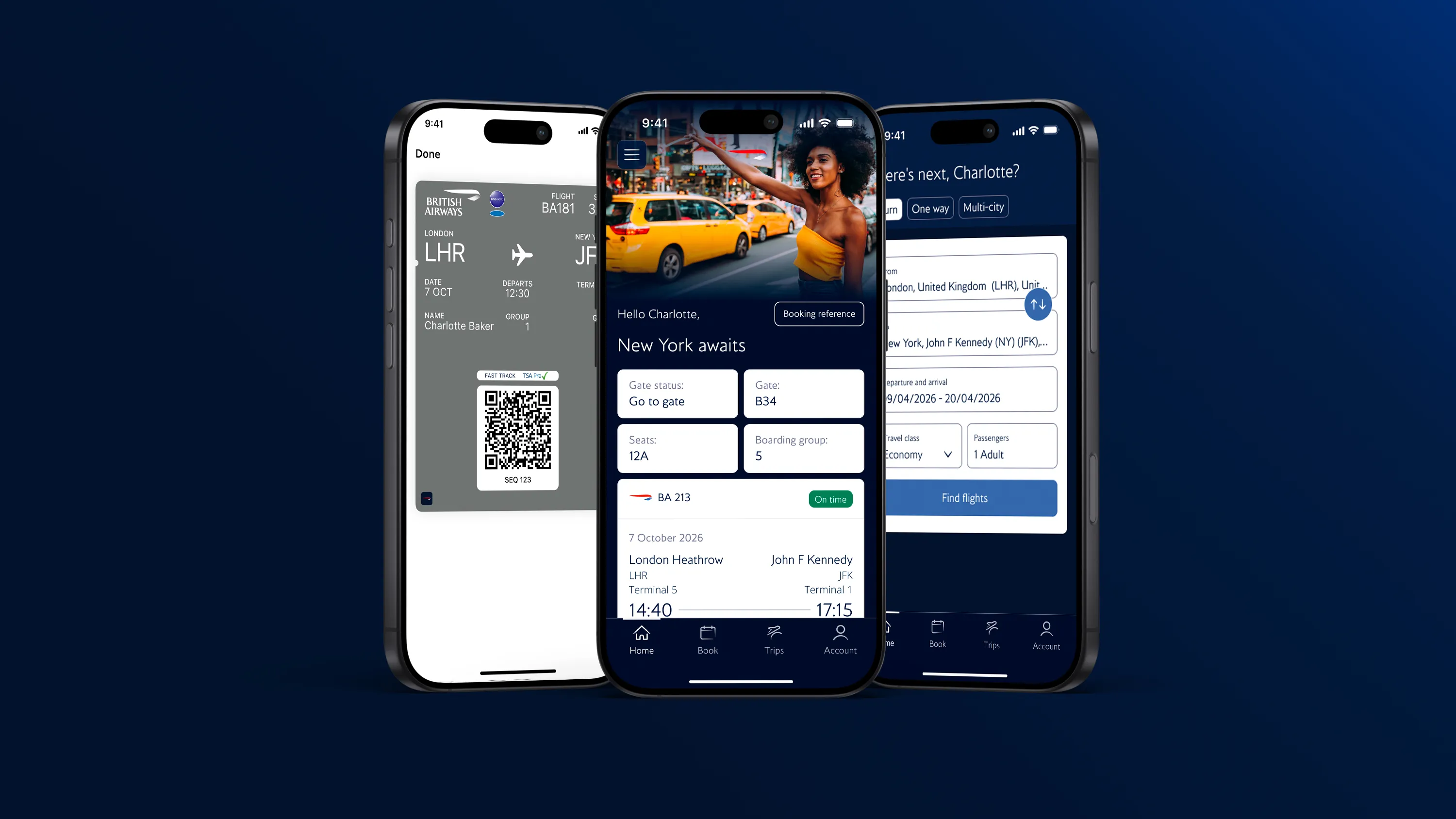
Overview
Every airline now competes with the best app on its customers’ phones, not just with other airlines.
For years, BA’s mobile app was understood as a distribution channel: a place for flight information, check-in and a degree of booking servicing, largely a shell of whatever ba.com could offer. Aviation is not alone in this. When digital products grow up inside commercial structures, they tend to inherit a channel’s sense of purpose. The £7bn transformation programme set out to replatform the entire digital estate, and the initial mobile brief reflected that starting point: build a new app with feature parity to the classic one.
That parity baseline was the real design challenge. Matching the old app would modernise the rails without changing what the product believed it was for.
Focus: Product vision, mobile experience strategy, design leadership
Scope: Leading design and research for the mobile product within the New BA.com & App programme
The Travel Companion model
The shift I have argued for, and now lead the design of, is from channel to product. A phone in a traveller’s pocket is a privileged position: present at booking, at packing, at the airport, in the air and at arrival. Treated as a channel, it distributes services. Treated as a product, it accompanies the journey, guiding and supporting customers continuously and letting them personalise their experience across every touchpoint of travelling with us.
That reframing implies a different purpose for the product, and a different way of organising the experience around the customer’s journey rather than around the services we distribute. It is also, deliberately, a model the modernised backend can actually power, which is what makes it more than ambition. The companion framing now fronts the product’s own public launch language.
Making the case by building it
A reframe like this is not won in a deck. The channel model is held in place by structure and habit, not by anyone’s bad intent, and arguments alone tend to bounce off it. So I treated the reframe as something to demonstrate rather than assert: build the smallest convincing version of the companion product, with the right team and tooling, and let the result carry the argument. Each piece of work below earns its place that way, as evidence first and a feature second.
A framework to design against
A vision needs a structure teams can build against, or it stays a slogan. I built a Customer Needs Framework for the mobile product: a hierarchy of five needs, from functional to emotional, adapted from established models of user experience. Information and Clarity, Convenience and Control, Assistance and Support, Personalisation and Intimacy, and Connection and Delight. Each layer names a real customer need, the known gaps in our current experience against it, and the opportunities open to us.
Its real job was shared language. Stated this way, the business could plan in terms of customer needs rather than channel features, which is the reframe made usable.
I pressure-tested the framework against best-in-class digital products, inside and outside aviation: the clarity of one carrier’s real-time journey tracking, another’s self-service disruption handling, a hotel group’s portable personalisation, a consumer flight tracker’s sense of delight. Benchmarking against the best consumer apps, not just other airlines, is the point. It is the standard a companion product is actually held to.
The framework then anchored a structured ideation programme with the team, using Kano analysis to sort blue-sky ideas into what customers treat as basic, what drives satisfaction and what creates delight, so prioritisation rested on customer logic rather than the loudest voice. This body of work established the mandate the mobile product is now designed against.
My role
I lead the in-house design and research team for the mobile product and direct a client-side delivery-partner design organisation, reporting two levels below the Chief Commercial Officer. In practice that means owning the Travel Companion vision, steering component evolution with the design system, and feeding squad delivery roadmaps as the new app moves from first release toward the fuller model.
Designing the first impression
The clearest test of channel thinking is the empty state: the home screen a customer sees when they hold no active booking. A channel treats that as dead space, a screen with nothing to distribute. A product treats it as the opposite, one of the highest-intent moments you get with a traveller, someone opening an airline app precisely because they are dreaming about going somewhere.
So we designed it as a discovery surface. The work was research-led in a literal, hands-on way. In co-creative sessions, a researcher guided participants through their ideal airline home screen while I sketched live alongside them, drawing each idea in real time and iterating together until the sketch matched their mental model. Those participant-authored designs were distilled into concepts, tested with a wider unmoderated panel, and the results shaped what shipped in the June 2026 release.
What made this fast is the point. Because the team owned the whole loop, I could take the tested direction to a working, functional prototype over two evenings, using AI-assisted tooling and our existing design system, real enough to put back in front of customers. That is idea to tested prototype in a fraction of the time the previous, partner-dependent model required, and it is the clearest evidence I have for what a senior in-house team with the right tooling can do. The strongest proposition that sat beyond the first release’s scope is parked on the roadmap rather than lost.
From vision to shipped enhancements
Vision work earns its keep only if it ships. In my first quarter leading the effort, I translated the framework into a concrete set of enhancements, each tied to a clear driver: brand compliance, accessibility, business need or experience improvement. Rebuilding the global navigation around a persistent top navbar and a tab bar mapped to customers’ core jobs to be done. Reworking the homepage and login into a more immersive, customisable structure with contextual quick actions. Defining the notification centre as the foundation of a broader customisation and CRM approach. Correcting typography that was not materially accessible on some devices, and bringing the splash screen and loader animations back into brand compliance.
Each enhancement moved from proposal to engineering-ready feature through technical feasibility input and prioritisation, the unglamorous work that turns a design direction into a roadmap a squad can deliver.
Where it stands
The first release of the new app launched in June 2026, following an extended beta programme. The design foundations are live inside the programme, informing the vision, the component system and what ships next.
The deeper outcome is organisational. Demonstrating what a properly resourced in-house team could deliver helped make the case for a shift now underway: building a senior in-house design and research function that owns strategy and directs partners, contractors and tooling for execution, rather than depending on partners for the thinking. That team is now being recruited.
The first release is a beginning rather than a destination. The companion model unfolds release by release as the platform’s capabilities come online, and I am happy to walk through the work, the model and the road ahead in person.