Overview
PizzaExpress knew its customers in the restaurant, but lost them the moment they bought a pizza anywhere else.
A PizzaExpress pizza might be eaten in one of 350+ restaurants, ordered through Deliveroo, or picked up in a supermarket. Across those channels the brand had no single way to recognise the same customer, and so no real picture of loyalty. In the Growth Studio at ENGINE, I was the experience designer who led the experience work through the discovery and definition phase, turning that problem into a designed, validated foundation before handing it off and moving on to Sky ahead of launch.
Focus: cross-channel earning architecture, loyalty mechanic logic, end-to-end flows, low-fidelity validation
Scope: experience foundation at ENGINE. I owned discovery and definition plus the first production sprint, before visual design and launch
The problem worth solving
The loyalty scheme was deliberately lopsided, and that was the point.
PizzaExpress wanted people back in its restaurants. So earning was weighted by channel: a dine-in visit earned a full stamp, a delivery or takeaway order earned half, a supermarket pack earned a twelfth. The business case lived or died on that weighting.
It handed me two hard design problems. First, legibility. A currency that pays out in full, half and twelfth increments is confusing, and a loyalty scheme people do not trust is one they ignore. Second, capture. How do you credit an earn from a supermarket shelf or a third-party delivery, channels the app never sees?
The architecture I designed
One currency, fed by every channel, including the ones the app could not control.
The load-bearing decision was the earning architecture: a single loyalty currency that could absorb earning events from dine-in, from delivery and from retail, normalise them into weighted visits, and always tilt the maths toward the restaurant.
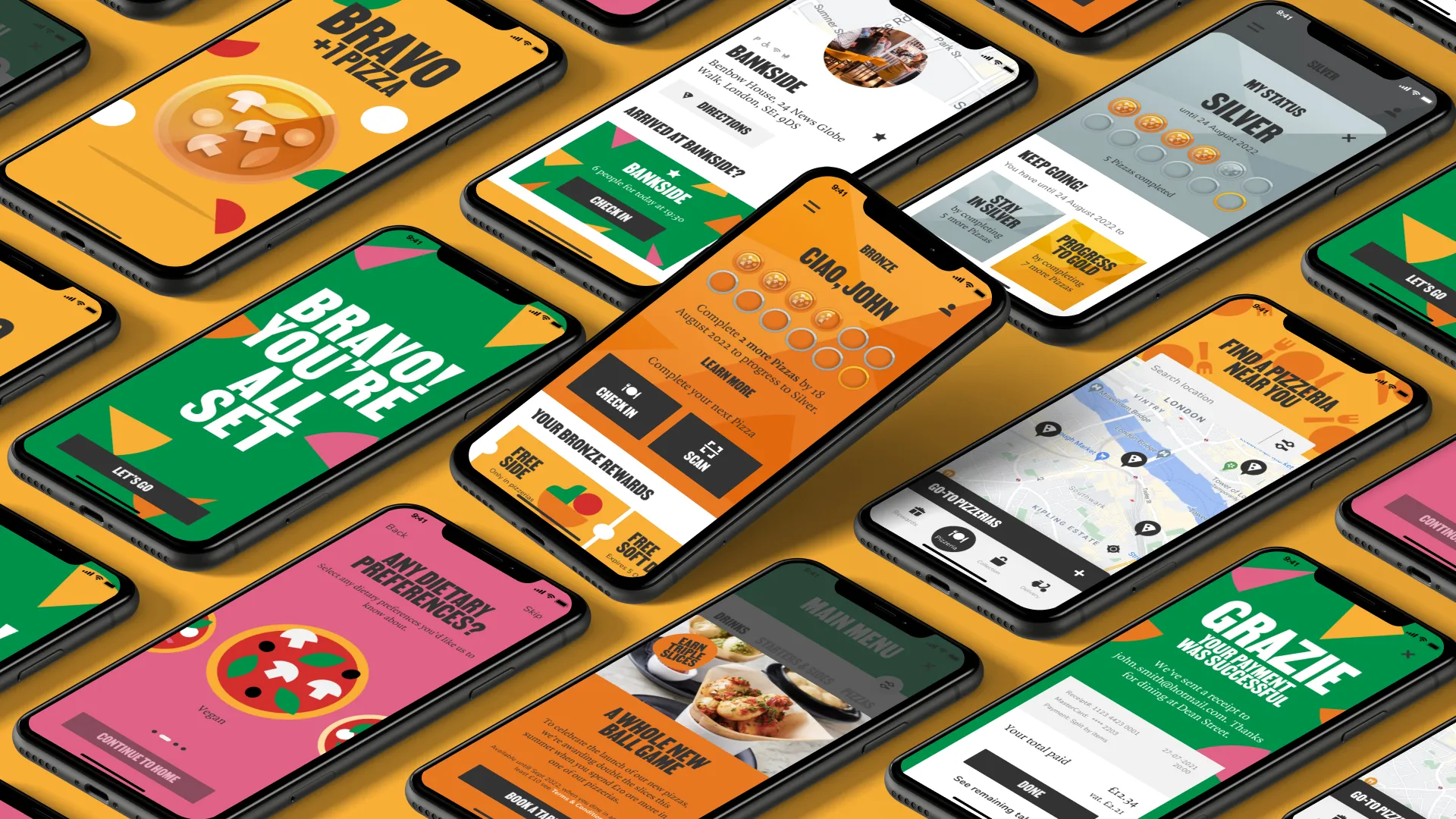
For the channels the app did not own, the capture mechanism was a QR scan, one on the supermarket packaging and one on the third-party delivery receipt. That pulled an off-platform purchase into the same ledger as a dine-in visit. I mapped the whole thing end to end, every journey in the app, as a single connected flow.
To be precise about the line: the experience architecture and the flows were mine. The back-end integration that made a scanned code actually credit an account sat with the development partner and the client.
The mechanic
A slice is a fraction of a visit. A full pizza is a whole one.
The slice metaphor is how I made the weighted economy legible. Rather than ask people to track full, half and quarter stamps, the design let them watch a pizza fill up: a full earn added a full pizza, a smaller earn added slices. The same object doubled as a progress bar, so a customer could read both where they stood and how close the next reward was, in a single glance.
The strategy
Loyalty as a driver to pull the first visit, loyalty as an outcome to sustain the rest.
The research posed a real product question: should loyalty lead the experience, or be the quiet result of a good one? I did not pick a side. I mapped each to a stage of the customer’s life with the brand.
Loyalty as a driver opens the relationship. Enrolling came with a welcome reward redeemable only in a restaurant, which made the first visit close to inevitable. Loyalty as an outcome sustains it. Once people were in, the app earned its place by making the visit itself better, through booking, check-in, the menu, splitting the bill and paying, so rewards accrued as the natural result. The slice mechanic is the connective tissue between visits. Every channel feeds the same pizza, so there is always a reason to reopen the app, and the weighting keeps nudging people back to the table.
How I validated it
I tested two philosophies, not two screens.
Before any of it went to visual design, I ran low-fidelity testing on two full prototypes, one built around loyalty as a driver and one around loyalty as an outcome. I wired the strategic question into the research itself: a mental-model section classified each participant by how they actually use loyalty schemes, so I could read every reaction against real behaviour rather than a stated preference.
Two findings shaped the handoff. The slice metaphor landed. People understood, unprompted, that filling the pizza moved them up a level. The value of the tiers did not. People could see they were progressing and could not say what they were progressing toward.
So I made two recommendations. The one that did not depend on back-end capability, surfacing progress inside the slice pattern itself, I designed and delivered. The one that did, contextual nudges at the moments that matter, such as a prompt at the bill or the menu showing the reward a customer was one slice away from, I specified as the validated next step for the build team. Drawing that line, between what the platform could do then and what it should do next, was part of the job.
What happened next
The brand changed. The structure did not.
The app launched as PizzaExpress Club in December 2021, the first omnichannel loyalty scheme of its kind in the UK, with pizza-slice stamps earned across supermarket, delivery and dine-in and tiered rewards. The product later moved to Dentsu Creative and was reskinned to a new visual identity. The earning architecture, the mechanic and the journeys underneath are still the ones I defined.
Outcome
The numbers belong to the launch. The foundation belongs to the work.
Public reporting since launch tells the rest: more than 2 million members in the first year, around 25% of PizzaExpress revenue now linked to the scheme, and 2.2 million stamp transactions a year. I cannot claim those post-launch figures as my delivery, and I would not. But the experience foundation they run on is the one I laid down.
What I took from it
The most durable design work is often the least visible. A reskin changes everything you can see and nothing that decides whether the product works: the structure, the flows, the logic of the mechanic. Building the part that survives a change of agency, a change of brand and several years in market taught me to invest in the skeleton, not the surface.